I build world models that let robots understand and act in unfamiliar environments. Currently in NYU Tandon's Control/Robotics Research Lab, and a research intern with Yann LeCun at AMI Labs.
R. G. Goswami, P. Krishnamurthy, Y. LeCun, F. Khorrami
Visual world models have shown great potential in learning complex system dynamics. Recent advancements leverage these models as transition functions within Model Predictive Control (MPC) frameworks to solve various control tasks. When applied to robotics, however, they are limited to single-stage tasks such as reaching or grasping, and struggle with multi-stage ones that demand complex sequential planning. In this work, we introduce WorldDP, a world model framework designed for multi-stage robotic manipulation. Our hierarchical approach utilizes a high-level world model as a transition function to optimize for feasible subgoals during runtime, which are subsequently reached by a low-level Diffusion Policy. To further aid in learning dynamics and planning, we incorporate object-centric representations that decouple environmental entities and enable us to plan sequentially with respect to each. Evaluated across several robotics benchmarks, WorldDP consistently outperforms existing baselines, validating that coupling the world model's physically grounded planning with diffusion policy's efficient execution yields superior multi-stage performance.
World Models for Learning Dexterous Hand-Object Interactions from Human Videos
R. G. Goswami, A. Bar, D. Fan, T. Yang, G. Zhou, P. Krishnamurthy, M. Rabbat, F. Khorrami, Y. LeCun
Modeling dexterous hand-object interactions is challenging as it requires understanding how subtle finger motions influence the environment through contact with objects. While recent world models address interaction modeling, they typically rely on coarse action spaces that fail to capture fine-grained dexterity. We, therefore, introduce DexWM, a Dexterous Interaction World Model that predicts future latent states of the environment conditioned on past states and dexterous actions. To overcome the scarcity of finely annotated dexterous datasets, DexWM represents actions using finger keypoints extracted from egocentric videos, enabling training on over 900 hours of human and non-dexterous robot data. Further, to accurately model dexterity, we find that predicting visual features alone is insufficient; therefore, we incorporate an auxiliary hand consistency loss that enforces accurate hand configurations. DexWM outperforms prior world models conditioned on text, navigation, or full-body actions in future-state prediction and demonstrates strong zero-shot transfer to unseen skills on a Franka Panda arm with an Allegro gripper, surpassing Diffusion Policy by over 50% on average across grasping, placing, and reaching tasks.
OSVI-WM: One-Shot Visual Imitation for Unseen Tasks using World-Model-Guided Trajectory Generation
R. G. Goswami, P. Krishnamurthy, Y. LeCun, F. Khorrami
Visual imitation learning enables robotic agents to acquire skills by observing expert demonstration videos. In the one-shot setting, the agent generates a policy after observing a single expert demonstration without additional fine-tuning. Existing approaches typically train and evaluate on the same set of tasks, varying only object configurations, and struggle to generalize to unseen tasks with different semantic or structural requirements. While some recent methods attempt to address this, they exhibit low success rates on hard test tasks that, despite being visually similar to some training tasks, differ in context and require distinct responses. Additionally, most existing methods lack an explicit model of environment dynamics, limiting their ability to reason about future states. To address these limitations, we propose a novel framework for one-shot visual imitation learning via world-model-guided trajectory generation. Given an expert demonstration video and the agent's initial observation, our method leverages a learned world model to predict a sequence of latent states and actions. This latent trajectory is then decoded into physical waypoints that guide the agent's execution. Our method is evaluated on two simulated benchmarks and three real-world robotic platforms, where it consistently outperforms prior approaches, with over 30% improvement in some cases.
RoboPEPP: Vision-Based Robot Pose and Joint Angle Estimation through Embedding Predictive Pre-Training
CVPR 2025IEEE/CVF Conference on Computer Vision and Pattern Recognition
R. G. Goswami, P. Krishnamurthy, Y. LeCun, F. Khorrami
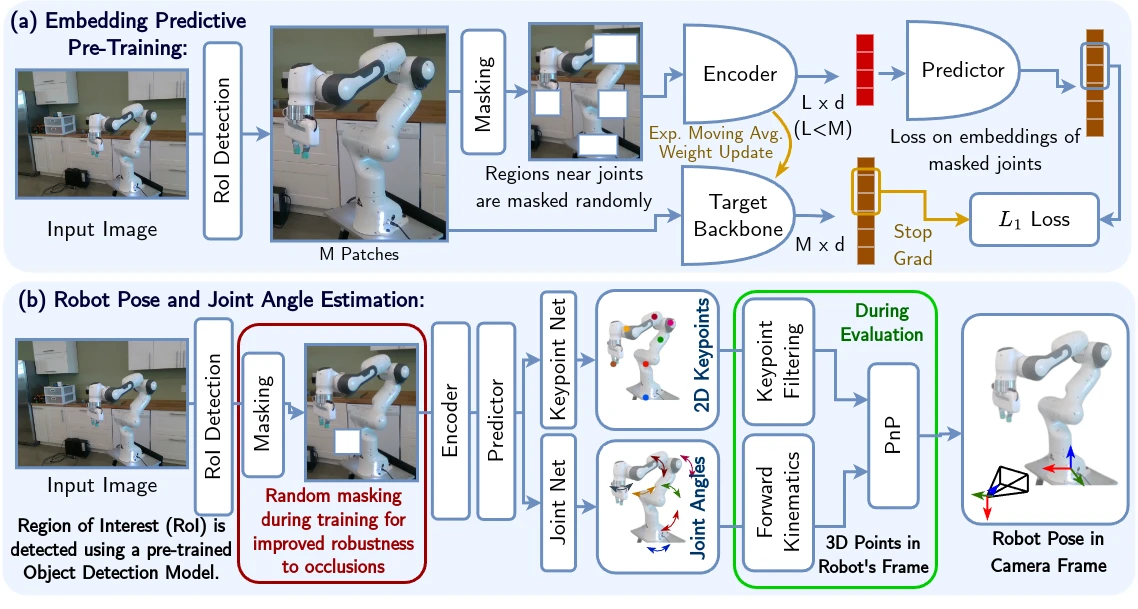
Vision-based pose estimation of articulated robots with unknown joint angles has applications in collaborative robotics and human-robot interaction tasks. Current frameworks use neural network encoders to extract image features and downstream layers to predict joint angles and robot pose. While images of robots inherently contain rich information about the robot's physical structures, existing methods often fail to leverage it fully; therefore, limiting performance under occlusions and truncations. To address this, we introduce RoboPEPP, a method that fuses information about the robot's physical model into the encoder using a masking-based self-supervised embedding-predictive architecture. Specifically, we mask the robot's joints and pre-train an encoder-predictor model to infer the joints' embeddings from surrounding unmasked regions, enhancing the encoder's understanding of the robot's physical model. The pre-trained encoder-predictor pair, along with joint angle and keypoint prediction networks, is then fine-tuned for pose and joint angle estimation. Random masking of input during fine-tuning and keypoint filtering during evaluation further improves robustness. Our method, evaluated on several datasets, achieves the best results in robot pose and joint angle estimation while being the least sensitive to occlusions and requiring the lowest execution time.
Open-Architecture End-to-End System for Real-World Autonomous Robot Navigation
R. G. Goswami, V. N. Devarakonda, A. U. Kaypak, N. Patel, R. Khorrambakht, P. Krishnamurthy, F. Khorrami
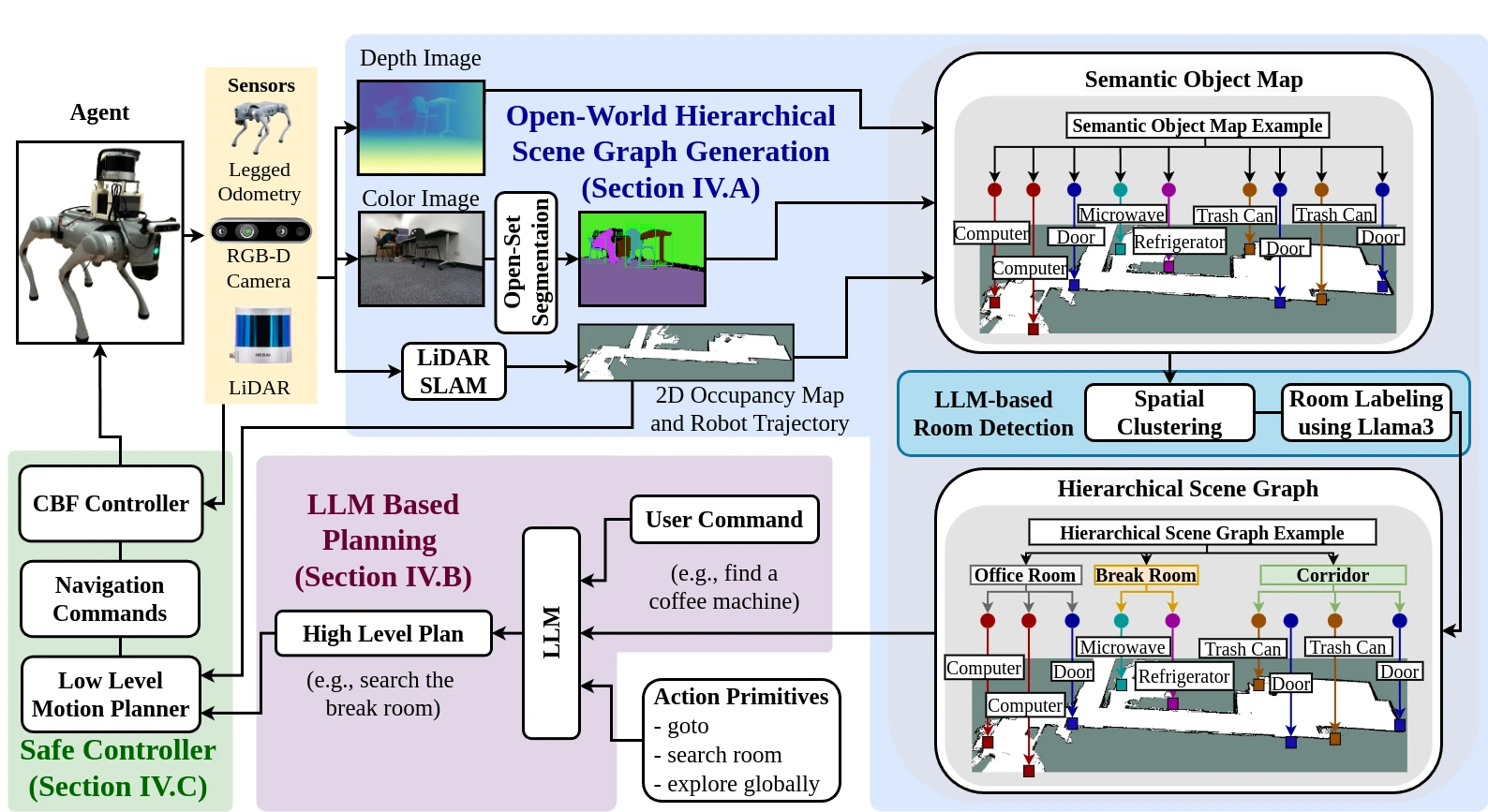
Enabling robots to autonomously navigate unknown, complex, and dynamic real-world environments presents several challenges, including imperfect perception, partial observability, localization uncertainty, and safety constraints. Current approaches are typically limited to simulations, where such challenges are not present. In this work, we present a lightweight, open-architecture, end-to-end system for real-world robot autonomous navigation. Specifically, we deploy a real-time navigation system on a quadruped robot by integrating multiple onboard components that communicate via ROS2. Given navigation tasks specified in natural language, the system fuses onboard sensory data for localization and mapping with open-vocabulary semantics to build hierarchical scene graphs from a continuously updated semantic object map. An LLM-based planner leverages these graphs to generate and adapt multi-step plans in real time as the scene evolves. Through experiments across multiple indoor environments using a Unitree Go2 quadruped, we demonstrate zero-shot real-world autonomous navigation, achieving over 88% task success, and provide analysis of system behavior during deployment.
FlashMix: Fast Map-Free LiDAR Localization via Feature Mixing and Contrastive-Constrained Accelerated Training
WACV 2025IEEE/CVF Winter Conference on Applications of Computer Vision
R. G. Goswami, N. Patel, P. Krishnamurthy, F. Khorrami
Map-free LiDAR localization systems accurately localize within known environments by predicting sensor position and orientation directly from raw point clouds, eliminating the need for large maps and descriptors. However, their long training times hinder rapid adaptation to new environments. To address this, we propose FlashMix, which uses a frozen, scene-agnostic backbone to extract local point descriptors, aggregated with an MLP mixer to predict sensor pose. A buffer of local descriptors is used to accelerate training by orders of magnitude, combined with metric learning or contrastive loss regularization of aggregated descriptors to improve performance and convergence. We evaluate FlashMix on various LiDAR localization benchmarks, examining different regularizations and aggregators, demonstrating its effectiveness for rapid and accurate LiDAR localization in real-world scenarios.
SALSA: Swift Adaptive Lightweight Self-Attention for Enhanced LiDAR Place Recognition
R. G. Goswami, N. Patel, P. Krishnamurthy, F. Khorrami
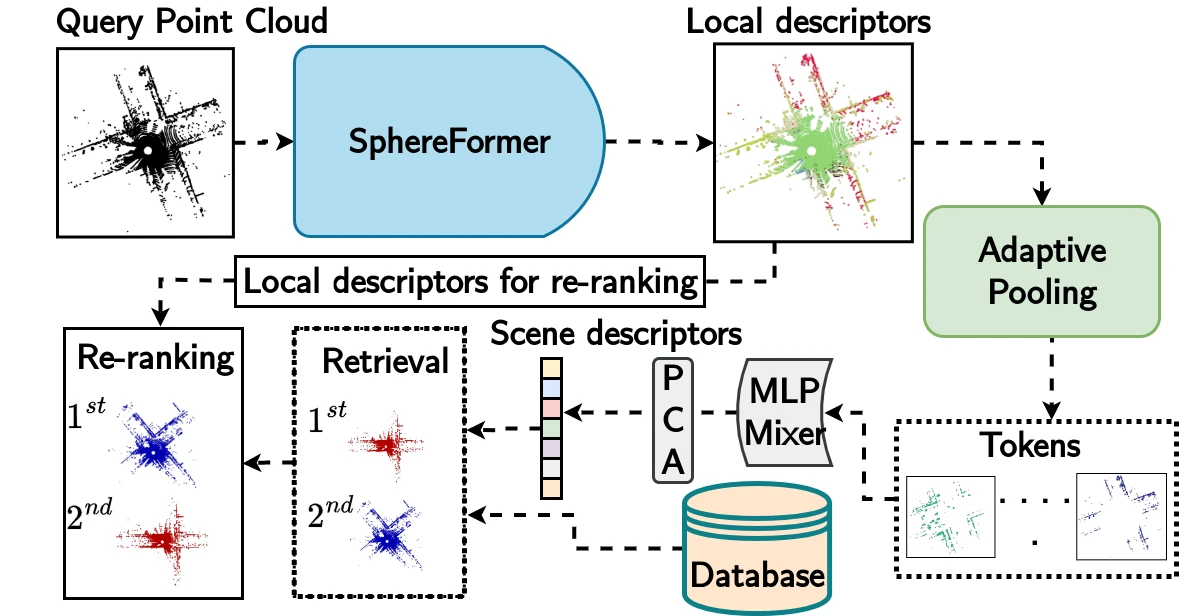
Large-scale LiDAR mappings and localization leverage place recognition techniques to mitigate odometry drifts, ensuring accurate mapping. These techniques utilize scene representations from LiDAR point clouds to identify previously visited sites within a database. Local descriptors, assigned to each point within a point cloud, are aggregated to form a scene representation for the point cloud. These descriptors are also used to re-rank the retrieved point clouds based on geometric fitness scores. We propose SALSA, a novel, lightweight, and efficient framework for LiDAR place recognition. It consists of a Sphereformer backbone that uses radial window attention to enable information aggregation for sparse distant points, an adaptive self-attention layer to pool local descriptors into tokens, and a multi-layer-perceptron Mixer layer for aggregating the tokens to generate a scene descriptor. The proposed framework outperforms existing methods on various LiDAR place recognition datasets in terms of both retrieval and metric localization while operating in real-time.
I was born and raised in Guwahati, in Northeast India, where my interest in science and technology took hold. I studied Electrical Engineering and Computer Science at the Indian Institute of Technology, Hyderabad, then began a Ph.D. at New York University, specializing in robot perception and computer vision.
Away from research I play guitar, hit the gym, and travel when I can. I am an enthusiastic viewer of long-form television like Game of Thrones, Peaky Blinders, and The Big Bang Theory. Most weekends I am somewhere between Park Slope, Greenwich Village, midtown Manhattan, and Williamsburg.