RoboPEPP Contributions
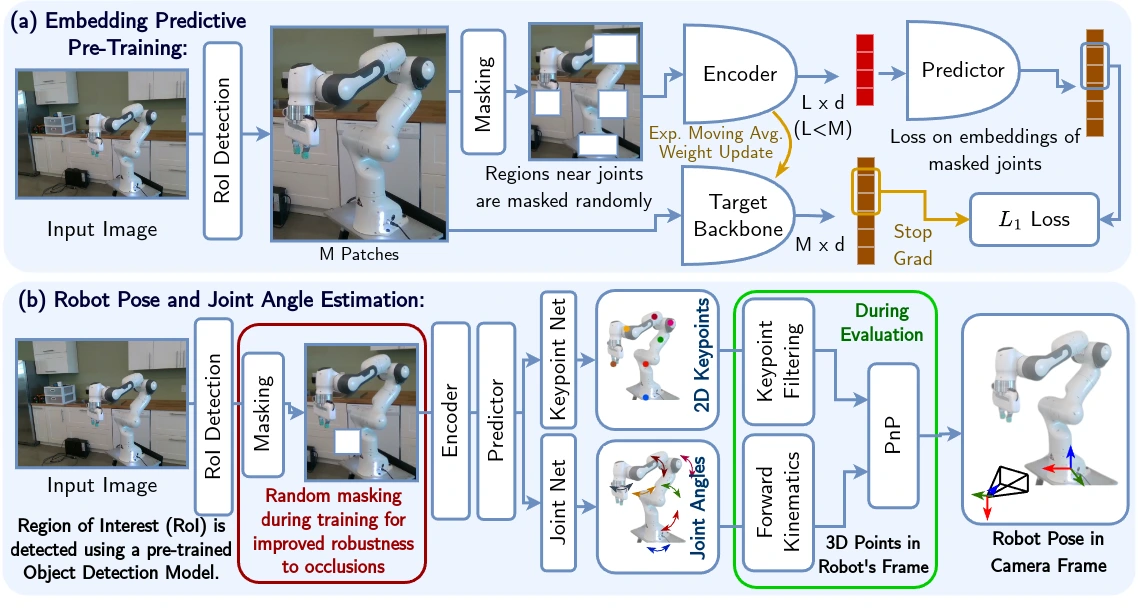
- Pre-Training: A robot pose and joint angle estimation framework with embedding-predictive pre-training to enhance the network’s understanding of the robot’s physical model.
- Fine-Tuning: An efficient network for robot pose and joint angle estimation using the pre-trained encoder-predictor alongside joint angle and keypoint estimators, trained using randomly masked inputs to enhance occlusion robustness
- Keypoint Filtering: A confidence-based keypoint filtering method to handle cases where only part of the robot is visible in the image
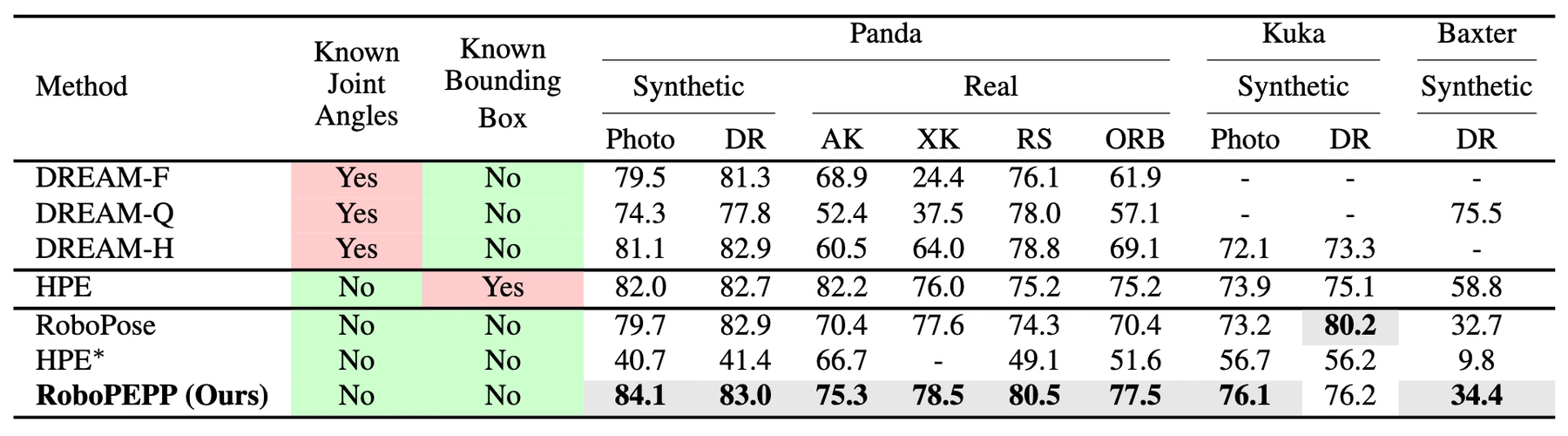
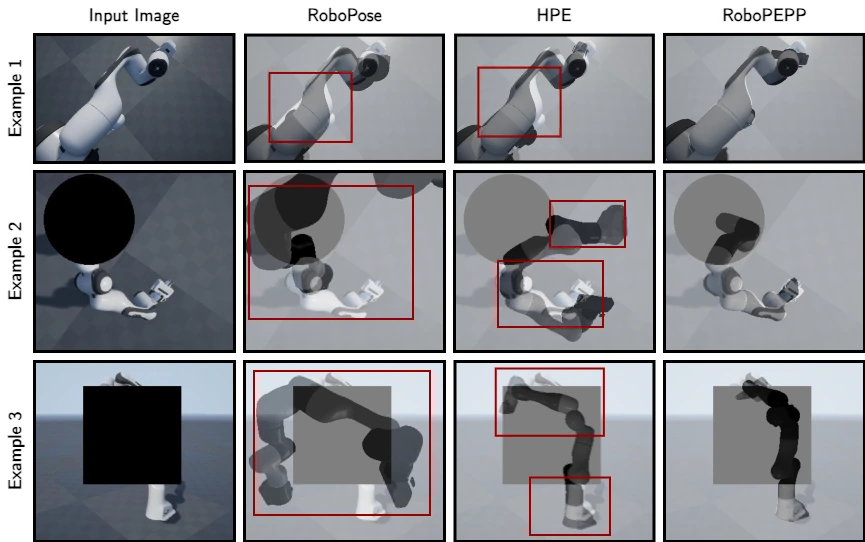
- Experiments: Extensive experiments showing RoboPEPP’s superior pose estimation, joint angle prediction, occlusion robustness, and computational efficiency.
Video
Results
Citation
@inproceedings{goswami2025robopepp,
  title={Robopepp: Vision-based robot pose and joint angle estimation through embedding predictive pre-training},
  author={Goswami, Raktim Gautam and Krishnamurthy, Prashanth and LeCun, Yann and Khorrami, Farshad},
  booktitle={Proceedings of the Computer Vision and Pattern Recognition Conference},
  pages={6930--6939},
  year={2025}
}